
Ban Gioc Waterfall: Tickets, Best Season and How to Visit

admin | 02/11/2025
BAN GIOC Waterfall, located on the border of Cao Bằng Province, is one of the most magnificent and beautiful waterfalls in Southeast Asia. The gentle Quây Sơn River suddenly plunges over layers of limestone cliffs, creating a curtain of white water that shimmers like a silver silk ribbon amid the mountains. When sunlight pierces through the mist, the falls glow with brilliance — powerful yet graceful, like a symphony between heaven and earth. Surrounding the waterfall is a poetic landscape of terraced rice fields, lush forests, and peaceful Tày and Nùng villages. Visitors can take a bamboo raft ride along the Quây Sơn River, feel the cool spray on their skin, and listen to the majestic rhythm of nature. Nearby, the hidden Ngườm Ngao Cave reveals a stunning world of glowing stalactites and stalagmites beneath the limestone mountains. With Jasmine Tour, travelers can experience the full magic of this region — from the misty majesty of Ban Gioc Waterfall to the mysterious charm of Nguom Ngao Cave — guided by locals who bring each story, legend, and landscape to life. Ban Gioc Waterfall is not only a famous travel destination but also a symbol of the raw, tranquil, and vibrant beauty of Cao Bằng, where humans and nature live in perfect harmony.

Ban Gioc Waterfall sits on the Quay Son River at Vietnam’s northern border with China, about eight hours by road from Hanoi. Entry costs 45,000 VND (roughly USD 2) and the site opens daily from 7:30am to 5:00pm. Bring cash — the ticket kiosk does not take cards.

It is the fourth-largest waterfall on any international border in the world, after Iguazu, Victoria and Niagara. But the number most travellers get wrong is the season: come at the wrong time and you will see a fraction of the water you came for.

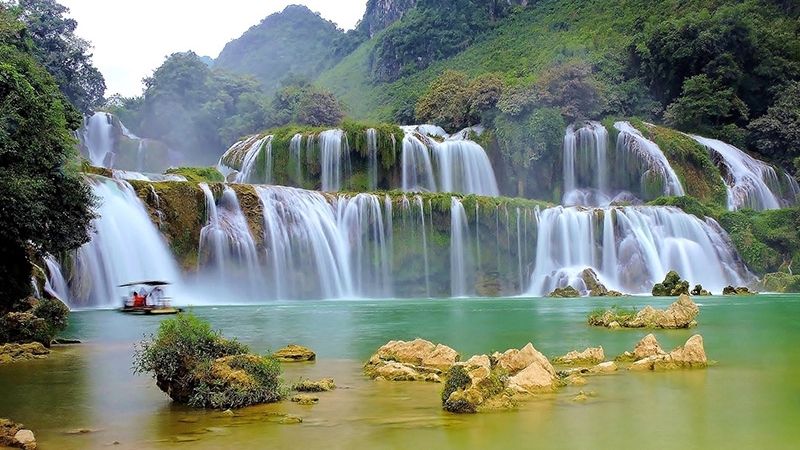
Ban Gioc Waterfall in full flow across the Quay Son River, Cao Bang

How much does it cost to visit Ban Gioc Waterfall?

Entry is 45,000 VND per person. Two optional extras are worth budgeting for:

  • Bamboo raft to the base of the falls — around 50,000 VND for a roughly 10-minute trip. This is the only way to feel the spray on your face.
  • Motorbike parking — 10,000 to 20,000 VND.

Budget about 100,000 VND per person to see the falls properly. Card payment is not available at the gate, so carry cash from Cao Bang town.

Bamboo raft carrying visitors to the base of Ban Gioc Waterfall

When is the best time to visit Ban Gioc Waterfall?

September and October give the best overall trip. The rainy season has filled the river, the skies have cleared, and the rice terraces in the surrounding valleys turn gold at harvest.

The trade-offs by season:

  • June to August — highest water volume, the falls at their most powerful. Early in this window the water often runs muddy brown from runoff.
  • August to September — flow is still strong but the water clears to blue-green. The best combination for photographs.
  • October to May — the dry season. The falls are gentler and no longer spread across their full width. Still beautiful, but a different experience.

Morning mist rising from the tiers of Ban Gioc Waterfall

How high and wide is Ban Gioc Waterfall?

Published figures vary widely depending on what is being measured — the main tier alone, the total drop, or the Vietnamese section versus the full transnational span. Oxalis Adventure reports a total width of 208 m and a height of 70 m, while several travel guides describe the main cascade as roughly 30 m over three tiers.

What is not disputed: it is the widest waterfall in Vietnam, and in full flow you cannot take it in from a single vantage point.

The falls split into two sections. The outer section straddles the Vietnam–China border and is the one in most photographs — three broad tiers, widest in the rainy season. The inner section lies entirely within Vietnam, runs in a single drop, and holds its shape better in the dry months. When guides say the falls “still run in March”, they usually mean this inner section.

Limestone peaks and terraced fields surrounding Ban Gioc, Cao Bang

How do you get to Ban Gioc Waterfall?

Ban Gioc is in Cao Bang province, roughly eight hours from Hanoi by road. Most travellers reach it as part of a Cao Bang loop itinerary rather than a single out-and-back trip, because the roads that lead there are the point.

The approach crosses Ma Phuc Pass, a switchback climb through limestone that most riders rate as the finest stretch of road in the province, and Khau Coc Cha Pass with its stacked hairpins.
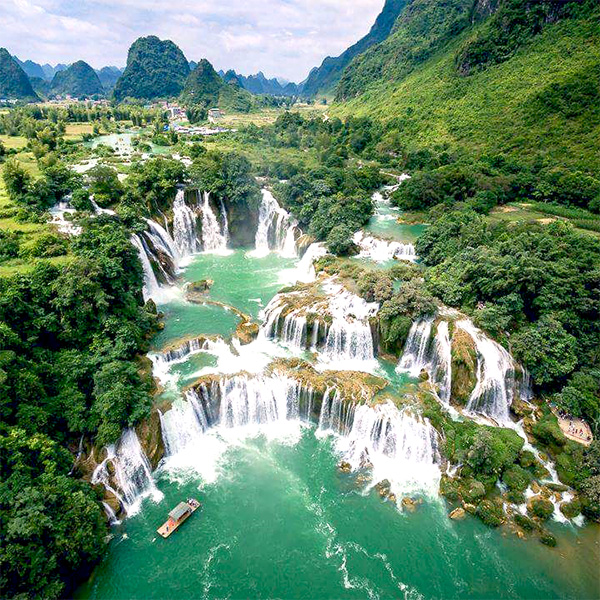
The border section of Ban Gioc Waterfall on the Vietnam-China boundary

What else is worth seeing nearby?

Nguom Ngao Cave is the standard pairing and sits a short drive from the falls. Where Ban Gioc is noise and open sky, the cave is silence and enclosed stone — the contrast is what makes the pairing work.

Pac Bo adds a historical stop, and the wider Cao Bang region holds enough to fill three or four days.

Stalactites inside Nguom Ngao Cave near Ban Gioc Waterfall

How long should you spend at Ban Gioc?

Allow three to four hours on site. That covers the main viewing platforms, the walk down to the water, the bamboo raft, and time to wait for the light to change. Travellers who budget one hour almost always regret it.

A workable two-day shape from Cao Bang town:

  • Day 1 — ride out over Ma Phuc Pass, stop at the viewpoints, reach Ban Gioc in the afternoon and stay overnight nearby. Late afternoon light suits the wide shots.
  • Day 2 — back at the falls for the 7:30am opening while the mist still sits on the water, then Nguom Ngao Cave before the return ride.

Doing Ban Gioc as a single day trip from Cao Bang town is possible but means arriving in flat midday light, which is the worst of the day for photographs.

What should you bring?

  • Cash. No card payment at the ticket gate, and the nearest reliable ATM is back in Cao Bang town.
  • A dry bag or waterproof phone pouch. The raft goes close enough that spray reaches you and your camera.
  • Shoes with grip. The steps down toward the water stay wet year round and get slippery in the rainy season.
  • Passport. You are at an international border; carry ID.
  • Light rain shell if travelling June to September — the weather here turns fast.

What should you know before you go?

  • Arrive at opening. Gates open at 7:30am; morning light on the falls is the reason to be there early rather than midday.
  • The border is real. The outer section marks the Vietnam–China boundary. Stay inside the marked area and follow the guards’ instructions.
  • The Chinese side is a separate country. What China calls Detian Falls is the same waterfall seen from the other bank. You cannot cross between them on a standard Vietnam visa.
  • Weekends and public holidays are busy. Domestic visitors fill the viewing platforms; a weekday visit is noticeably quieter.

Travelling here with Jasmine Tours

Ban Gioc is part of our Cao Bang routes, run with local riders who know which viewpoints hold water late in the dry season. Every trip contributes to Plant Today – Green Tomorrow, our tree-planting programme in the highlands.
Jasmine Tours group at the Ban Gioc Waterfall viewpoint

Sources

Entrance fee, opening hours, raft and parking prices: The Loop Tours and Local Vietnam (accessed 10 August 2026). Dimensions and world ranking: Oxalis Adventure (accessed 10 August 2026). Seasonal water conditions: BestPrice Travel (accessed 10 August 2026). Prices are indicative and change — verify before travel.

There is 0 comment, review about Ban Gioc Waterfall: Tickets, Best Season and How to Visit

TVQuản trị viênQuản trị viên

Xin chào quý khách. Quý khách hãy để lại bình luận, chúng tôi sẽ phản hồi sớm

Trả lời.
Thông tin người gửi
Comment
Click here to rate
Sender information
0
Shopping cart, 0 products
There are no products in your shopping cart.
0.07714 sec| 944.063 kb